JOURNEY ANALYSIS

Exploring Communication in Journey through the Chirp mechanic

Immersed in an endless ocean of sand, you begin your journey. You gaze at the massive mountain towering like a titan in the distance, its summit calling out to be reached.
As you embark on your adventure, you might be surprised by a soft chime, a chirp that soon enough will become very familiar. A fellow traveler has joined your journey. No usernames, no chat, not even emotes, all you have to communicate is this chirp, which the environment and strange, cloth-like creatures also seem to respond to.
Journey is the third game of Thatgamecompany, a studio known for crafting moving experiences that are beautiful in both form and substance. Originally released in 2012 on PS3, the game saw a surge in popularity when it was released on PC in 2019.
Although working together with your traveling companion isn’t required — since you can complete the game even offline, by yourself — not doing so drifts you away from the developers’ envisioned experience. If you let yourself be carried by the journey, you'll weave a strong bond with your companion. Follow this path, and you'll face trials and support each other to the end.


"We wanted to create an environment where the cooperation is not forced; you're totally fine doing it yourself. If you choose to cooperate, then that is the real essence of connecting two players." - Jenova Chen for GameDeveloper.

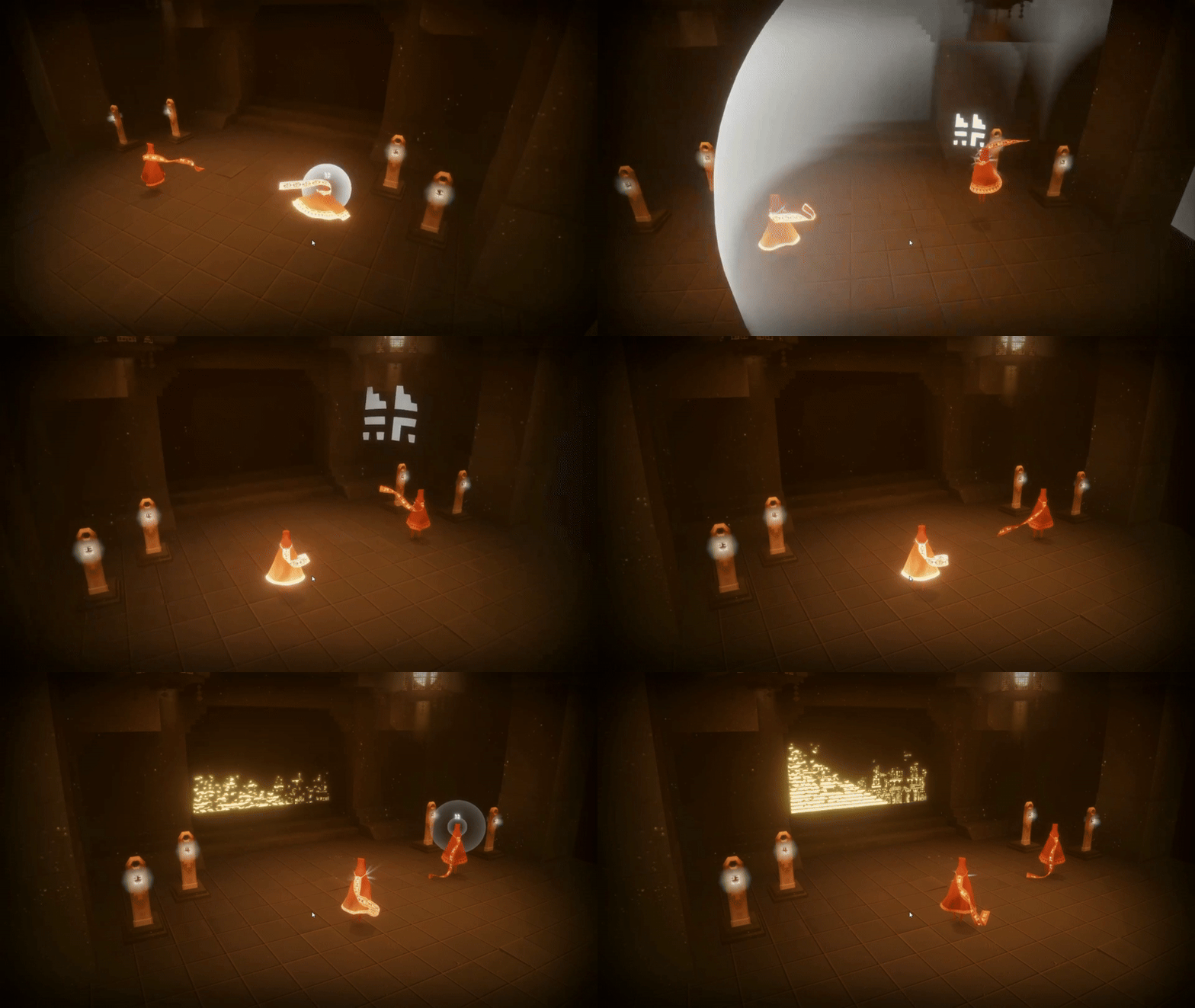
Journey doesn’t overwhelm players with mechanics, instead focusing on a versatile interactive feature that complements the almost contemplative nature of the game.
The community named it the “chirp”: a simple chime that you can charge up to amplify its sound and reach, allowing you to interact with the environment and your fellow traveler.
Today, 13 years after Journey’s original release, few games have managed to create such a strong, emotional approach to multiplayer. This unique experience all starts with how we communicate with our companion: through the chirp.
To better understand how a minimalist mechanic and its surrounding design choices can have such a strong impact on the game feel, I wondered:
How is the chirp designed to be the perfect communication tool to engage the player in Journey’s ideal experience?


The mechanic is first introduced as your sole way to interact with your environment. Early in your journey, you learn to use it regularly to solve small puzzles and progress through the desert. After your companion joins you, you use it instinctively to say hi. Unknowingly, the foundations of your unique shared language have just been laid.
In other multiplayer games, we see chats, emotes, voice chat, usernames, and often much deeper gameplay systems. But in Journey, there’s just the chirp.
In an interview for GamesIndustry.biz, Jenova Chen (co-founder of Thatgamecompany) explained that player behavior reflects the environment they’re surrounded in.
Give someone a weapon and a "teabagging" animation, and they'll immediately think about killing and humiliating others. That’s why the devs chose to not include any usernames, gender, age, even arms to the players to prevent hitting or pushing.

Everything was designed to create an environment that brings out compassion and cooperation, whether hidden deep inside or not. Even players who are usually toxic often end up writing heartfelt gratitude letters to complete strangers. It reflects a beautiful faith in humans’ natural kindness. And the chirp is the final thread that truly ties two companions together.
One of Jenova Chen's ambitions in the making of Journey and games in general is to show the world how games can be both emotional and intellectual. The chirp is the embodiment of this vision. By stripping away language barriers, age barriers, and cultural barriers, he places players in an environment where everyone has the same power and the same tool: the chirp.


Journey isn’t the only example of how simplified communication tools have tailored an environment fit for the game’s experience. The Dark Souls games also used a unique message system, offering only certain words and hard-earned emotes.
This shaped a unique language throughout the whole community. Messages help, warn, and even the occasional troll has shaped the community’s distinct humor. Emoting became a standard of respect, even PvP feels chivalrous, with fair play, honor, and pride.
This kind of emergent language is born from players’ creativity using the tools they’ve been given. And Journey, in its minimalism, allows that same creativity through the ability to charge the chirp.
By varying its range and intensity, players can express various intentions. A unique, intimate language forms between each duo. Clumsy at first, it naturally evolves into an implicit code. A short chirp to say “I’m here”, a long one to mean “follow me” or to celebrate a shared success.
And yet, it’s very possible that these two players never fully understand each other. There’s no guarantee your companion gets what you mean. But the game is designed so that it doesn’t really matter: the connection is there. The bond goes beyond language, it’s found in the shared emotion of overcoming ordeals together.
“When you put the two players together online and put them in a difficult environment, they will create a bond.” - Jenova Chen


Reflecting on it all, the chirp is the heart of Journey’s emotional power. It strips everything down to its core: two strangers, side by side, with a simple sound to bridge the gap, capturing something universal about human connection. And yet, through this, deep connections form. I felt that deeply during my own playthroughs. It reminded me of the day I climbed a real mountain in Slovenia under 30°C, with no water left for hours. The same sense of pushing through a tough ordeal, the same quiet pride when I reached the top.
Journey connected deeply to me and a big part of it was thanks to my anonymous companion, who, though chirps, made me feel supported. This mutual support gave me energy to keep pushing even though I was only behind a screen. And for me, it felt just as real as that mountain.
This article is an analysis based on my personal experiences and observations of Journey's gameplay and design. All images and gameplay screenshots are from my own playthrough. Here are some articles I used to gather more information:
IGN Unfiltered 2 - Interview of Jenova Chen by Ryan McCaffrey, 2018
Game Developper - A Personal Journey: Jenova Chen's Goals for Games by Ed Smith, 2012
Games Industry - Ten years later, Jenova Chen reflects on Journey by Brendan Sinclair, 2022